To a pessimist, the Chinese character for "crisis"
(危)
signifies danger and calamity. However, to an optimist, it is a source of strength.
Does the top component of 「危」
not resemble the character 「力」
(power/strength), slightly deformed as if drained of energy? Viewed this way,
a crisis can be seen as a situation that traps hardship (
「厄」 )
within its last breath. A modern interpretation suggests that without crises,
there are no opportunities—acting, in effect, as a form of paradoxical encouragement.
If a real-world example is needed to demonstrate this perspective,
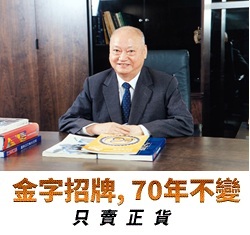
the success of the late Mr. Chan Luk — a prominent figure in the metals industry —
and his company, KTB Ltd., began with the word "crisis."
Shanghai Merchant Turns Crisis into Opportunity
As KTB Ltd. celebrates its 70th anniversary, the enduring legacy of its late founder,
Mr. Chan Luk, and the achievement of its second-generation management team stand as
a testament to their continuous diligence and resilience in surviving adverse
and dangerous environments.
Back in the 1940s, the late Mr. Luk was already a thriving merchant in Shanghai,
known for his bravery and commercial insight. He traded in daily necessities,
such as bicycles and tires, which were considered contraband by the Japanese
occupying authorities. In 1949, recognizing their essential role in manufacturing,
he began dealing in axles. Naturally, these products—commonly referred to
as 「啤令」 (bearings) by people in Hong Kong—gave him his first taste of major success.
Upon arriving in Hong Kong, he returned to his roots and resumed trading in bearings.
Mr. Luk came to a new place, Hong Kong, in 1953 to start it all over.
Arriving in Hong Kong, he went back to his old business - trading in bearings.
In 1956, he invested HKD 50,000 in Central District to establish King Tah Steel Ball
& Bearing Company, officially launching his career in the bearing industry.
Working Diligently to Turn Crises into Opportunities
At the time, most bearings were traded without local sole agents; instead,
transactions went through foreign-owned trading houses known as “HONG”.
Business owners had to split profits with these trading houses while being careful
not to lock up excessive capital in inventory. Facing these constraints,
the late Mr. Luk worked harder than anyone else. He carefully balanced every
order by selectively adding to his inventory—ensuring his shop had sufficient
stock without tying up vital cash flow. He recognized that to keep his business
moving, he had to rely on these trading houses to sell in bulk for smaller,
more frequent returns. Although foreign bearing suppliers were eager to
bypass trading houses and deal directly with end-users,
the agency system at the time had not yet matured.
Recognizing this opportunity, the late Mr. Chan Luk seized the initiative,
capitalizing on low interest rates to expand the business and establishing "KTB Ltd."
to purchase directly from overseas manufacturers. This strategic move laid
a solid foundation for the group to ascend as an authorized distributor for
numerous world-renowned bearing brands. Demonstrating remarkable foresight and
courage, he further expanded his inventory during periods of low Hong Kong
dollar interest rates and rising foreign currency values, yielding substantial
additional profits for the company.
Order quantities for bearings varied dramatically at the time—ranging from a
few thousand units to five-digit figures. Consequently, most merchants avoided
holding large inventories. Delivery lead times were equally unpredictable,
spanning anywhere from 2–3 months to a full year. The late Mr. Luk realized
that to succeed, he needed a comprehensive inventory to prevent stockouts
and encourage repeat business. He established a founding motto for the company:
always maintain a complete product line to satisfy every customer demand.
A Savvy Businessman Outpaces the Rest
It is rare to navigate business without facing crises—especially as an enterprise grows.
Amid the social turbulence and economic challenges of 1960s Hong Kong, the late Mr. Luk
drew upon his experience having survived the Chinese Civil War. During that period,
he not only traded in bearings but also acted as an agent for manufacturing machinery.
Light industry was taking off across Hong Kong and Southeast Asia, causing orders to
flood in. The moment machines arrived, they were immediately loaded for shipment.
It can truly be said that the business expanded through crisis. While luck played a role,
the late Mr. Luk's tireless work ethic—working 365 days a year—was the true differentiator.
Perseverance is essential in business, and it was this mindset that helped KTB overcome
yet another challenge.
Overcoming Market Counterfeits
The opening up of China’s market initially appeared to present a major challenge to
companies like KTB; even the CEPA agreement could not fully mitigate the risk.
Rapid industrialization in Mainland China created a booming domestic market for
imported bearings, which directly impacted Hong Kong suppliers selling the same products.
Yet, rather than seeing its business shrink, KTB expanded.
Although the challenge originated in Mainland China, it took deep local insight to
resolve it. Massive demand led to a market flooded with counterfeit bearings—some
made of ordinary iron disguised as high-grade steel. These counterfeits posed severe
hazards, causing machinery breakdowns and costly production halts. While machine
manufacturers could absorb the time and financial cost of repairs, factory owners
relying on those machines suffered severe losses in time, money, and reputation—all
due to an inferior bearing.
Because of this, Mainland manufacturers and engineers traveled to Hong Kong specifically
to source from KTB, renowned for selling exclusively genuine, high-quality brands.
When the late founder retired, he handed the business the second generation.
The second-generation leadership brought fresh energy to the firm, drawing on experience
gained from launching ventures in Taiwan, Southeast Asia and the United States. They
applied the founding philosophy of high-volume, low-margin sales while doubling down on
quality and service, enabling sales to grow even in a tough market environment.
Despite KTB’s established reputation in Southern China, the family decided to expand
further north into Mainland China to secure long-term growth. The key to business success
lies in listening to sound advice, but only those who execute with unwavering diligence
achieve lasting success.
Captions
• Products: KTB is an authorized distributor for numerous world-renowned bearing brands,
including German brands (FAG, INA, GMN, STIEBER, RINGSPANN), British brands
(RHP, WESTON, COOPER, SNFA), French brands (SNR, NADELLA), Swiss brands (RMB, WIB),
American brands (TIMKEN, TORRINGTON, MORSE, FAFNIR, MRC, McGILL, RBC, DODGE, SMITH,
KAYDON, LINK-BELT, LOVEJOY), and Japanese brands (NSK, IKO, EZO, OZAK, JAF, FYH, TSUBAKI,
MTR, DAIDO). In the early days, Japanese suppliers approached the founder to act as
their agent. At the time, few anticipated that the quality of Japanese brands
would one day rival or exceed that of European and American manufacturers.
• Leadership: KTB's second-generation management team inherits their father's
dedicated work ethic while introducing dynamic strategies and modern perspectives
to the group.
• Legacy: The late Mr. Luk kept a commemorative tripod in his office, symbolizing
the family working together in unity for KTB’s ongoing prosperity.
|


